

Smart Cards on Interakt give you full context about your users while you’re having a conversation with them in the Shared Team Inbox.
In this article, we’ll help you understand what Smart Cards are and the different types available on Interakt.
What are Smart Cards?
Smart Cards are the cards you see on the right-hand side of Interakt’s Shared Team Inbox. They are much like helper cards. With Smart Cards, you will have access to all your customer information while talking to them.
You can click on the Customize button on the top right corner to disable any card that you’re currently not using and you can even rearrange the cards in an order that you find most important.
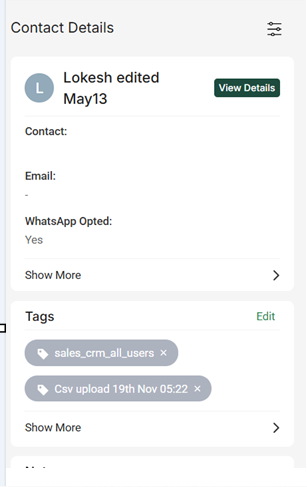
1. Personal Details Card
The Personal Details Card displays all the basic details of your user. Every time a user sends you a message or you reach out to the user – Interakt captures their name and number, & more as given on WhatsApp, automatically.
You can edit the fields in this card manually by clicking on the edit button on the top right corner.
Additionally, with the help of Interakt’s APIs, you also get to define and capture any other user attributes that are important to your business for example – sign-up date, total orders placed or other parameters that might be relevant for your business.
As you keep adding more custom fields, they will then be shown on this card and you can view them all when you click on ‘Show More’.

If you click on View Details, you will be able to see more details about the users and you can edit the details as well.

If you click on the View Details, you will land on the Contact Hub page of that user, where in you can view all the details and make edits as well.

2. Tag Card
1. The Tag Card in the Interakt’s inbox lets you add relevant tags to your conversations and users. The tags can be defined by you and your teammates to classify your users.
2. To add a tag you need to simply click on ‘Edit’ & select an existing tag or create a new one and click on Save Tags.

You can also edit the tags by clicking on the Edit button.
Notes Card
1. In the Notes Card, you can type out the user details that you want to capture, and then click on ‘Add’.
Every time you or any of your teammates open up a chat head with this user – the notes that you have added here will then be visible, for quick reference.
You can also see the date on which the note was created and you even have options to edit or delete the note.

Conversation History Card
The Conversation History Card gives you and your teammates an overview of all the previous chats with your users.
Every time you mark a chat as closed, it forms a conversation thread. Interakt then pulls up the entire thread of your conversation with that user and then shows it in the Conversation History Card for quick reference.

When you click on a closed conversation thread which is marked in red, the messages in that conversation will pop up like this – as shown below.

Events
The Events card in the Interakt shared team inbox acts as a real-time activity log for each customer. It provides agents with a transparent view of the customer’s journey, moving beyond just the conversation text to show the “behind-the-scenes” interactions.
In this example, the card displays a chronological list of significant actions, such as Notification Sent and Click Tracking. This allows agents to see exactly where a customer stands in a marketing or support flow without leaving the chat screen.
Campaign & Template Names: Identifies exactly which marketing push or automated message prompted the customer to engage.
Message Lifecycle: Tracks the “Sent,” “Delivered,” and “Read” status with precise timestamps. This helps agents gauge customer interest or identify if a user is currently active.
Interaction Data: The Click Tracking event shows specific Call-to-Action (CTA) engagement, including the exact link clicked and the button text (e.g., “Check out the Post”).

Order History
For Shopify merchants using Interakt, the Order History card is a powerful bridge between your storefront and your WhatsApp inbox. It provides agents with instant commerce context, ensuring they never have to fly blind during a sales or support conversation.

This helps in Contextual Conversations, for instance, if an agent sees that a customer just clicked a specific link in a promotional WhatsApp message, they can tailor their responses to that specific product or topic.
Mark As Spam
You can also mark a user as Spam if you no longer wish to communicate with them. This will ensure that you don’t receive any messages from the users.

We hope this article helped you understand what is Smart Card and how you can leverage it to supercharger your Customer Support operations.